Ahead of the 2026 season, Croatia has been discussing price levels and value in tourism more openly. Tourism minister Tonči Glavina called on the sector to lower expectations, margins and prices. That is a broad tourism discussion, not a statement directed at marinas.
For crews and boat owners, however, it leads to a practical question: how have published berth prices in the cruising area actually changed? In Croatia, berth costs are no longer just a detail at the end of the day. They can influence routing, reservations, the choice between marina, town quay and buoy field, and the way a crew plans critical nights.
The analysis below shows how published ACI berth prices developed from 2020 to 2026. It helps crews and boat owners put price movements into context, understand differences between berth types and include berth costs more consciously in passage or long-term planning. It does not assess service quality, business background or individual operator decisions.
Why berth costs now matter earlier in the plan
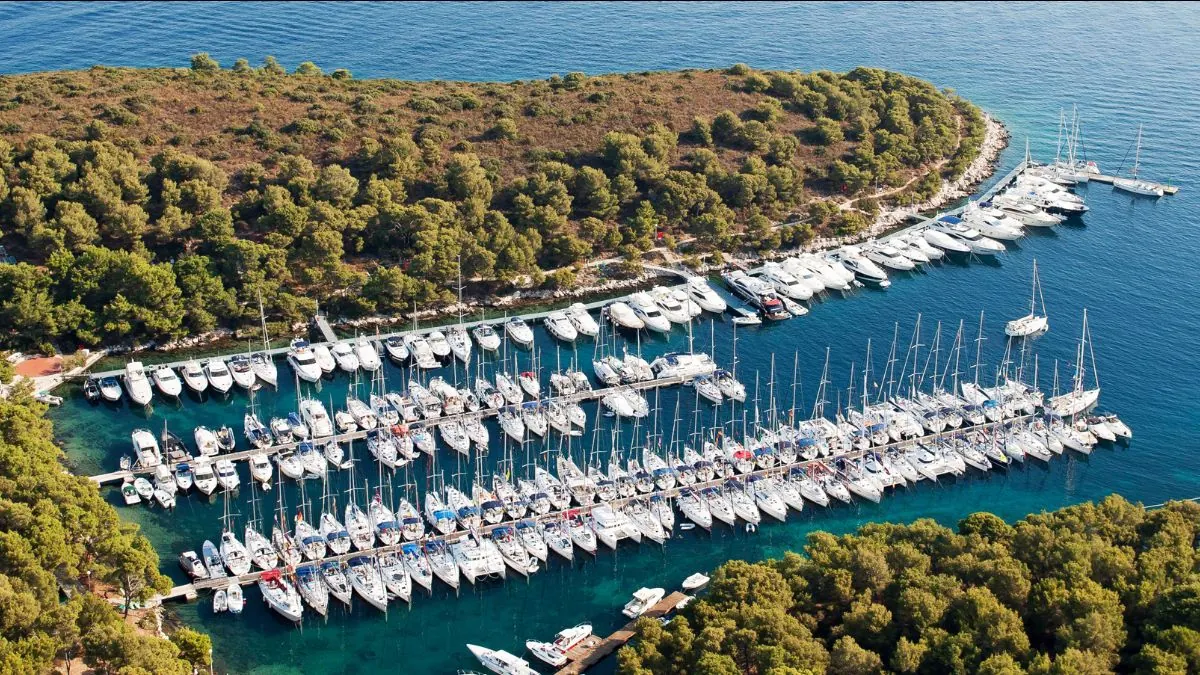
For charter crews, daily berths are usually the most visible cost. A marina night can make sense when water, shore power, provisioning, crew change or weather are part of the plan. At the same time, the price of that night can influence whether a crew books early, heads for a town quay or plans a more sheltered anchorage or buoy field instead.
For owners and crews staying longer in the area, monthly and yearly berths matter more. These are not one-off evening costs; they become a planning factor for weeks or an entire season. They affect budget, base selection and the choice of region.
The practical conclusion is simple: in a busier and more structured cruising area, berth planning should start earlier. Not to remove flexibility, but to understand which stops are critical.
What was analysed?
The editorial analysis is based on 3,262 individual values derived from ACI price lists. It includes the lists for 2020, 2021, 2022, 2023, 2024, 2025 and 2026. From 2024 to 2025 there were no price changes; all prices were carried over unchanged from the previous year.
Only berths in the water were included, for boat lengths from 10 to 17 metres. Dry berths, crane and travel-lift services, buoy prices, apartments, catamaran or trimaran surcharges and marina-specific weekend surcharges are not part of the comparison.
For daily and monthly berths, the highest published seasonal tariff was used for each marina, year and boat length. For yearly berths, the listed annual price was used. HRK price lists from 2020 to 2022 were converted at the fixed rate of 1 EUR = 7.53450 HRK.
The main finding: monthly berths stand out in 2026
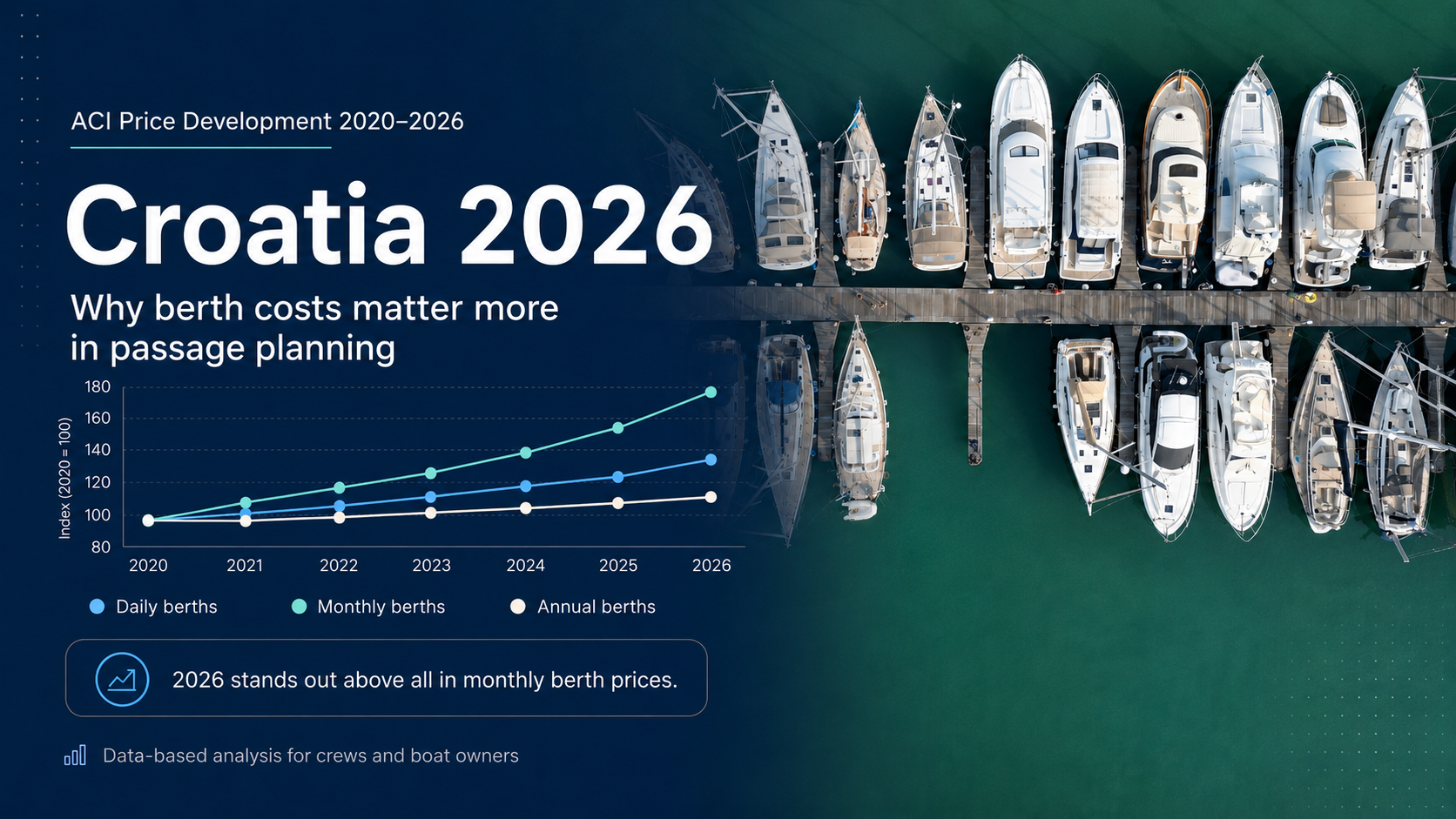
The strongest overall jump in the equal-weight index occurs in 2026 compared with 2025: plus 37.1 percent. This index gives equal weight to daily, monthly and yearly berths. The important point is the interpretation: the 2026 jump is driven mainly by monthly tariffs.
By berth type, the picture is more nuanced. Daily berths show their largest average year-on-year rise in 2023 compared with 2022, at plus 11.0 percent. Yearly berths also rise most strongly in 2023, at plus 8.1 percent. Monthly berths are different: in 2026, compared with the unchanged 2025 level, the average increase is plus 92.8 percent.
For crews, this means daily prices have clearly risen, but without a single extreme break. Yearly berths show a steadier line as well. The striking change in the overall analysis sits with monthly berths in 2026.
Development since 2020
Across the full period from 2020 to 2026, average daily berths rise from €106.1 to €146.5, an increase of 38.1 percent. Monthly berths rise from €1,353.0 to €3,185.1, or 135.4 percent. Yearly berths move from €6,188.6 to €8,014.0, an increase of 29.5 percent.
The pandemic years 2020 and 2021 appear as a calmer phase in several series. The upward movement becomes more visible in 2022 and 2023. That is useful context, but not a causal claim. The data does not prove that the pandemic, tourism recovery or individual market decisions caused the price development.
Yearly berths 2020-2026 by boat length
| Boat length | 2020 | 2021 | 2022 | 2023 | 2024 | 2025 | 2026 |
|---|---|---|---|---|---|---|---|
| 10 m | €3,796.0 | €3,818.3+0.6% | €4,018.1+5.2% | €4,340.5+8.0% | €4,558.5+5.0% | €4,558.50.0% | €4,916.8+7.9% |
| 11 m | €4,315.8 | €4,340.7+0.6% | €4,567.7+5.2% | €4,934.1+8.0% | €5,182.0+5.0% | €5,182.00.0% | €5,589.2+7.9% |
| 12 m | €5,047.0 | €5,073.8+0.5% | €5,338.0+5.2% | €5,766.1+8.0% | €6,055.7+5.0% | €6,055.70.0% | €6,532.4+7.9% |
| 13 m | €5,669.9 | €5,699.8+0.5% | €5,996.8+5.2% | €6,477.3+8.0% | €6,802.3+5.0% | €6,802.30.0% | €7,337.9+7.9% |
| 14 m | €6,261.0 | €6,293.8+0.5% | €6,621.7+5.2% | €7,157.7+8.1% | €7,516.4+5.0% | €7,516.40.0% | €8,107.9+7.9% |
| 15 m | €6,881.7 | €6,900.0+0.3% | €7,259.2+5.2% | €7,846.9+8.1% | €8,240.3+5.0% | €8,240.30.0% | €8,888.7+7.9% |
| 16 m | €8,097.6 | €8,141.9+0.5% | €8,579.3+5.4% | €9,273.7+8.1% | €9,738.3+5.0% | €9,738.30.0% | €10,504.1+7.9% |
| 17 m | €8,807.8 | €8,855.7+0.5% | €9,331.3+5.4% | €10,086.8+8.1% | €10,591.9+5.0% | €10,591.90.0% | €11,424.7+7.9% |
Yearly berths rise much more steadily than monthly berths. The strongest year-on-year rise in this category is in 2023; 2026 still sits clearly above the unchanged 2025 level.
2026 price ranges: same length, different marina
| Length | Berth type | Lowest marina | Minimum | Highest marina | Maximum | Factor |
|---|---|---|---|---|---|---|
| 12 m | Daily berth | S.DRAGA | €86 | ROVINJ | €204 | 2.37× |
| 12 m | Monthly berth | S.DRAGA | €1,950 | SPLIT | €3,800 | 1.95× |
| 12 m | Yearly berth | KORČULA | €4,918 | SPLIT | €9,592 | 1.95× |
| 15 m | Daily berth | OPATIJA | €114 | ROVINJ | €256 | 2.25× |
| 15 m | Monthly berth | OPATIJA | €2,550 | ROVINJ | €4,600 | 1.80× |
| 15 m | Yearly berth | KORČULA | €6,688 | SPLIT | €12,850 | 1.92× |
| 17 m | Daily berth | S.DRAGA | €128 | ROVINJ | €312 | 2.44× |
| 17 m | Monthly berth | S.DRAGA | €2,900 | ROVINJ | €5,400 | 1.86× |
| 17 m | Yearly berth | KORČULA | €8,476 | SPLIT | €17,542 | 2.07× |
The spread between the ACI marinas included in the analysis is substantial. For yachts between 12 and 17 metres, the difference between the lowest and highest ACI marina reaches roughly double, or more, in several categories.
Region and marina matter
The following table shows the lowest and highest ACI marina by region and berth type, based on 2026 average base prices across 10 to 17 metres within each marina. It is not a quality ranking; it simply shows the price spread inside each region.
| Region | Berth type | Lowest marina | Ø 10-17 m | Highest marina | Ø 10-17 m |
|---|---|---|---|---|---|
| Istria | Daily berths | UMAG | €111.5 | ROVINJ | €253.3 |
| Istria | Monthly berths | UMAG | €2,512.5 | ROVINJ | €4,366.7 |
| Istria | Yearly berths | PULA | €6,321.8 | ROVINJ | €12,544.3 |
| Kvarner | Daily berths | S.DRAGA | €100.5 | CRES | €137.2 |
| Kvarner | Monthly berths | S.DRAGA | €2,262.5 | CRES | €3,093.8 |
| Kvarner | Yearly berths | S.DRAGA | €7,008.0 | OPATIJA | €9,064.5 |
| Northern Dalmatia | Daily berths | ŠIMUNI | €118.5 | PIŠKERA | €160.2 |
| Northern Dalmatia | Monthly berths | ŠIMUNI | €2,668.8 | SKRADIN | €3,612.5 |
| Northern Dalmatia | Yearly berths | ŠIMUNI | €6,237.8 | VODICE | €8,237.5 |
| Central Dalmatia | Daily berths | VRBOSKA | €130.5 | SPLIT | €188.0 |
| Central Dalmatia | Monthly berths | VRBOSKA | €2,950.0 | SPLIT | €4,250.0 |
| Central Dalmatia | Yearly berths | VRBOSKA | €6,416.5 | SPLIT | €11,780.0 |
| Southern Dalmatia | Daily berths | DUBROVNIK | €146.0 | SLANO | €161.2 |
| Southern Dalmatia | Monthly berths | DUBROVNIK | €2,800.0 | KORČULA | €3,831.2 |
| Southern Dalmatia | Yearly berths | KORČULA | €5,972.2 | DUBROVNIK | €9,471.8 |
Protection, location, availability, services and reservation options may matter more than the lowest number in a table. But the spread is real enough to justify looking at the berth question early.
Notable monthly jumps in 2026
Trogir (Central Dalmatia)
Monthly berths:
€1,116.2 to €3,818.8
An increase of 242.1%.
Slano (Southern Dalmatia)
Monthly berths:
€1,260.5 to €3,643.8
An increase of 189.1%.
Pomer (Istria)
Monthly berths:
€1,264.8 to €3,031.2
An increase of 139.7%.
Korčula (Southern Dalmatia)
Monthly berths:
€1,600.8 to €3,831.2
An increase of 139.3%.
Pula (Istria)
Monthly berths:
€1,262.2 to €2,912.5
An increase of 130.7%.
All five of the largest marina-based year-on-year jumps in the analysis are monthly berths from 2025 to 2026. This clearly shows why monthly tariffs stand out in 2026. For crews and boat owners, this is not a reason for drama, but a useful signal to look more closely at monthly berths when planning and comparing prices.
What this means for crews and owners
For charter crews, berth costs should be part of the route conversation earlier than they used to be. Not every night needs to end in a marina, and not every marina decision is about price. But in busy areas, it helps to know which nights are worth reserving and where a town quay, buoy field or sheltered anchorage may be the more practical choice.
For owners and longer-stay crews, monthly and yearly prices show the broader trend. The monthly category changes far more sharply in 2026 than daily or yearly berths. Anyone planning to keep a boat in Croatia for several weeks should compare not just the region, but also the exact marina and berth type.
Boat size also matters. In this analysis, the average yearly berth for a 17-metre yacht in 2026 is around 74.9 percent higher than the 12-metre value. Possible multihull surcharges are not included.
Price is still only one part of the decision. Shelter in bora or jugo, access to services, distance to the route, berth availability and crew logistics may be more important than the lowest tariff. Good planning brings cost, safety and the day’s rhythm together.
Conclusion
The Croatian tourism debate shows that value for money is a visible topic before the 2026 season. The ACI analysis explains why the question is relevant for boaters too. Daily berths have risen noticeably, yearly berths more steadily, and monthly berths stand out clearly in 2026.
For both passage planning and long-term costs, it is worth looking more closely at region, boat length and berth type. The next practical question follows naturally: when does a marina make sense in Croatia, when a town quay, and when a buoy field?
Sources and methodology: The analysis is based on the ACI price lists for 2020, 2021, 2022, 2023, 2024, 2025 and 2026 and our own editorial evaluation. The statements by the Croatian minister refer to the Morski.hr article “Glavina: Ovo je bitna godina, smanjite cijene” from 10 May 2026. All values are published ACI tariffs, average prices or highest published seasonal tariffs in the present analysis; base prices without surcharges or ACI card discount. Electricity and water costs were not included in the analysis.